HTTPS reverse proxy has become a standard architecture in modern enterprise environments. Common use cases include:
- TLS termination at a unified entry point
- Hiding internal service topology
- Load balancing and traffic routing
- Centralized certificate and security policy management
When choosing a reverse proxy, two names dominate almost every discussion:
- Apache HTTP Server
- Nginx
This article does not focus on simplistic claims like “which one is faster,” but instead compares how Apache and Nginx behave differently when acting as an HTTPS reverse proxy, especially in real-world enterprise operations.
1. Executive Summary (For Busy Decision Makers)
| Scenario | Better Fit |
|---|---|
| Existing Apache / PHP ecosystem | Apache |
| High concurrency, API gateway | Nginx |
| Complex access logic & legacy systems | Apache |
| Lightweight, performance-first proxy | Nginx |
👉 There is no universal winner — only the right tool for the job.
2. HTTPS Reverse Proxy Architecture
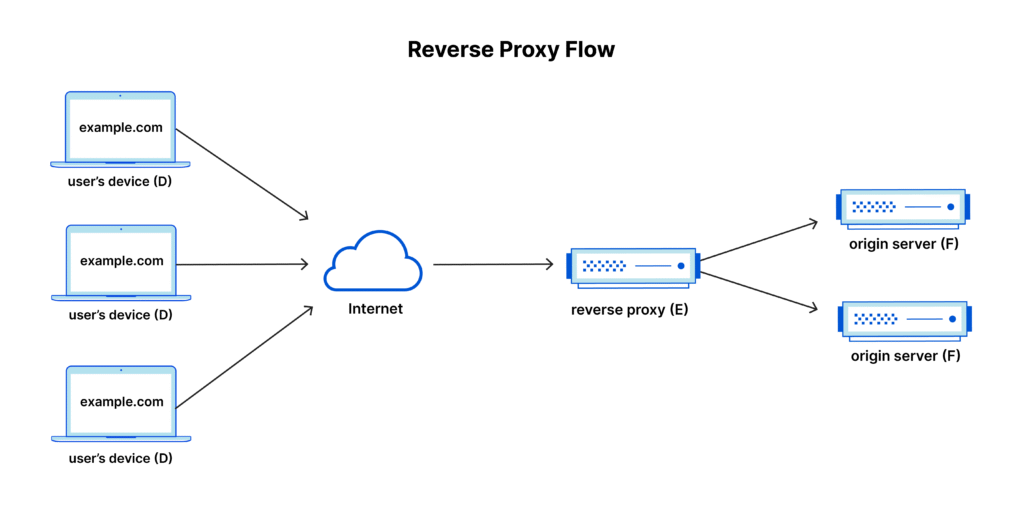
Browser
│ HTTPS
▼
Reverse Proxy (Apache / Nginx)
│ HTTPS
▼
Backend Services
In this model, the reverse proxy plays two roles simultaneously:
- HTTPS server (facing clients)
- HTTPS client (connecting to backend services)
This dual role is exactly where Apache and Nginx begin to differ significantly.
3. Core Difference #1: Architecture Model
Apache: Process / Thread-Based
Apache traditionally uses a process- or thread-based request handling model (depending on MPM):
- One request per process or thread
- Highly modular architecture (
mod_ssl,mod_proxy,mod_rewrite) - Clear and explicit configuration semantics
Strengths
- Configuration is readable and expressive
- Mature modules and predictable behavior
- Excellent for complex rules and legacy integration
Weaknesses
- Higher memory usage under high concurrency
- Reverse-proxy-only performance is not its strongest area
Nginx: Event-Driven, Non-Blocking
Nginx is built from the ground up as an event-driven proxy server:
- One worker can handle thousands of connections
- Designed primarily for reverse proxying and load balancing
- Minimalist configuration language
Strengths
- Extremely high concurrency
- Low memory footprint
- Ideal for APIs and microservices
Weaknesses
- Complex logic is harder to express
- Debugging can be more difficult
- Dynamic behavior often requires reloads
4. Core Difference #2: HTTPS and Certificate Verification
Apache: Secure by Default, Explicit Control
Apache treats backend HTTPS connections as first-class TLS clients:
- Backend certificate verification is explicit
- Internal CA and enterprise PKI are well supported
- Secure defaults are easier to enforce
Example:
SSLProxyEngine On
SSLProxyVerify require
SSLProxyCheckPeerName on
SSLProxyCACertificateFile /etc/apache2/ssl/internal-ca.pem
👉 Very enterprise-friendly for internal PKI environments
Nginx: Flexible but Easy to Misconfigure
By default, Nginx:
- Does not verify backend certificates
- Can silently accept untrusted HTTPS connections
To enable proper verification, you must explicitly configure it:
proxy_ssl_verify on;
proxy_ssl_trusted_certificate /etc/nginx/internal-ca.pem;
proxy_ssl_server_name on;
👉 Many deployments believe they are “secure” simply because HTTPS is used, while certificate validation is actually disabled.
5. Core Difference #3: Configuration Style and Readability
Apache: Declarative and Human-Readable
ProxyPass /api https://backend.internal/api
ProxyPassReverse /api https://backend.internal/api
- Easy to read and review
- Well suited for documentation and handover
- Configuration logic is explicit
Nginx: Directive-Oriented and Compact
location /api/ {
    proxy_pass https://backend.internal/api/;
}
- Concise and efficient
- Optimized for performance
- Less intuitive for newcomers
6. Operations & Troubleshooting Perspective (Often Overlooked)
Apache
- Clear and descriptive error logs
- SSL and proxy errors are usually self-explanatory
- Easier root-cause analysis for certificate issues
Nginx
- Error messages are often minimal
- TLS issues frequently require
openssl s_clientfor diagnosis - Configuration errors may prevent reload entirely
7. Is Performance Really the Deciding Factor?
In HTTPS reverse proxy scenarios, overall performance is often dominated by:
- TLS handshake cost
- Backend response time
- Network latency
👉 In most enterprise internal systems:
- Apache performance is more than sufficient
- The real bottleneck is usually the backend service or database
8. Practical Selection Guidelines (Infrastructure View)
Choose Apache if you:
- Already run Apache extensively
- Need complex rewrite, auth, or conditional logic
- Use internal CA / enterprise PKI
- Value clarity and long-term maintainability
Choose Nginx if you:
- Handle high-concurrency APIs
- Operate in containerized or cloud-native environments
- Want minimal resource usage
- Have strong engineering discipline for config management
9. Conclusion: Don’t Choose Based on “Speed” Alone
The real difference between Apache and Nginx is not raw performance, but philosophy:
- Apache → stable, explicit, enterprise-oriented
- Nginx → lightweight, high-performance, engineering-oriented
In HTTPS reverse proxy deployments, choosing the right tool depends on:
Your system complexity, security requirements, team expertise, and operational model
The best reverse proxy is the one your team can operate securely and confidently over the long term.