From “Issuing Certificates” to Operating a Trust Infrastructure
In many enterprises, the reality of Internal PKI looks like this:
- An internal CA exists
- Certificates can be issued
- But no one dares to rotate, revoke, or even touch it
As a result:
PKI becomes a hidden landmine instead of a security foundation.
This article focuses on one thing only:
How to design and operate an Internal PKI that is actually usable, maintainable, and survivable in an enterprise environment.
No theory-heavy discussions — only practical architecture and operational lessons.
1. What Is the Real Goal of an Enterprise Internal PKI?
In practice, Internal PKI is not about matching public CAs feature-for-feature.
Its real goals are:
- Controllable internal trust
- Damage containment when certificates leak
- Survivability during personnel changes
- Scalable trust without rebuilding everything
👉 The keyword is operability, not sophistication.
2. Practical Enterprise PKI Architecture Overview
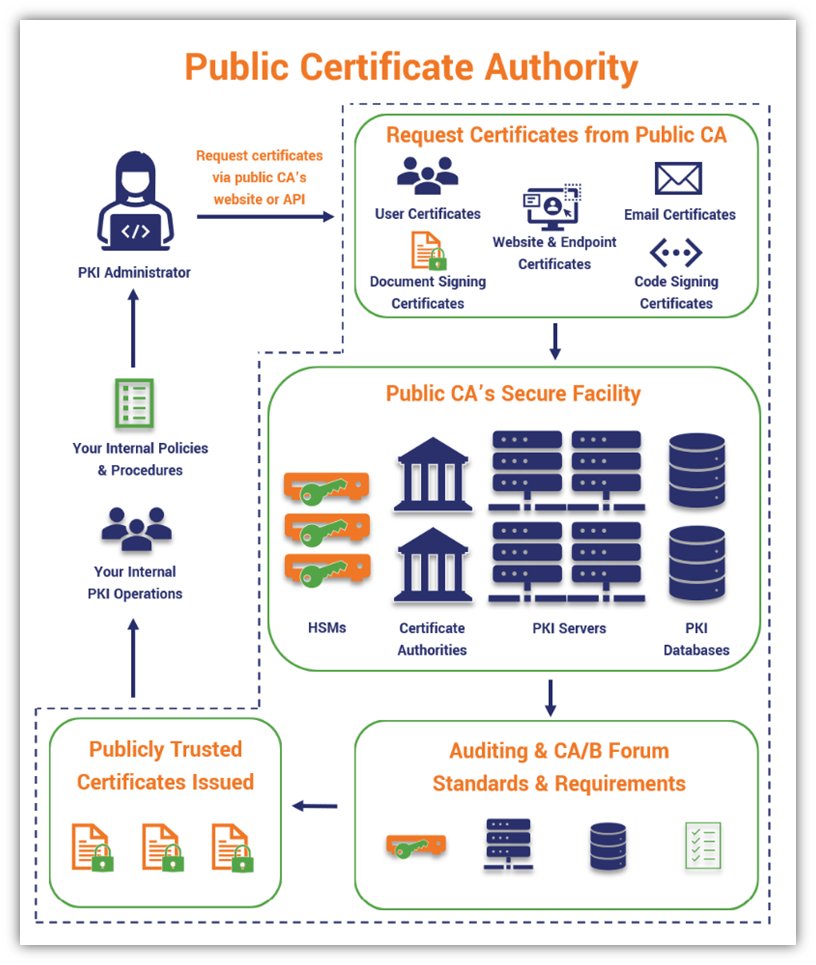
Offline Root CA
│ (Rarely used)
▼
Intermediate CA (Active)
│
├─ Web / API Certificates
├─ Reverse Proxy Certificates
├─ Mail / LDAP / VPN Certificates
└─ (Optional) Client / mTLS Certificates
Core Roles
- Root CA → Trust anchor
- Intermediate CA → Operational authority
- Certificates → Short-lived, replaceable assets
3. Root CA: The Most Critical and Most Misused Component
Correct Role of the Root CA
- ❌ Not for daily certificate issuance
- ❌ Not stored on servers
- ❌ Not owned by a single administrator
Root CA Best Practices
- Fully offline (never network-connected)
- Encrypted private key
- Multi-person custody (at least two people)
- One purpose only: sign Intermediate CAs
The Root CA exists so that the enterprise can recover from worst-case scenarios.
4. Intermediate CA: The Real Operational Battlefield
Why Enterprises Must Use an Intermediate CA
Every enterprise will eventually face:
- Mis-issued certificates
- Suspected private key compromise
- System migrations
- Architecture changes
👉 Intermediate CAs can be revoked. Root CAs cannot.
Practical Recommendations
- Validity: 3–5 years
- Purpose-specific (multiple intermediates if needed):
- Web / API CA
- Infrastructure / Device CA
- Online with strict access control
- Semi-automated issuance workflows
5. Certificate Classification Strategy (Non-Negotiable)
❌ Common Mistakes
- One certificate used everywhere
- One CA signing all certificate types
✅ Practical Classification
| Certificate Type | Purpose |
|---|---|
| Web / API | HTTPS services |
| Proxy | Reverse proxy endpoints |
| SMTP / IMAP / Submission | |
| Infrastructure | LDAP / VPN |
| Client | mTLS / devices |
👉 Purpose separation = risk isolation
6. SAN and Naming Strategy (90% of TLS Issues Start Here)
Practical Rules
- SAN entries must be minimal and precise
- Avoid wildcard certificates
- Do not add “maybe useful later” names
Example (Good)
DNS: api.internal.corp
DNS: api
Example (Bad)
DNS: *.internal.corp
7. Certificate Lifetime and Rotation Strategy
Recommended Validity
| Component | Validity |
|---|---|
| Root CA | 10–20 years |
| Intermediate CA | 3–5 years |
| Server Certificates | 90 days – 1 year |
Why Shorter Lifetimes Matter
- Limits blast radius of leaks
- Encourages automation
- Reduces “fear of touching PKI”
8. Trust Distribution Strategy (Do Not Trust Everything Everywhere)
Correct Approach
- Apache / Nginx trust only required CAs
- Docker images include only necessary CA certs
- Clients trust CAs by purpose, not globally
Dangerous Approach
- Installing Root CA on all employee machines
- Making every system trust every CA
9. Revocation and Incident Response (You Will Need This)
Enterprise Reality
- Internal systems often do not check OCSP in real time
- That is acceptable only if you can answer:
✔ Which certificate is revoked?
✔ Which systems are affected?
✔ How fast can replacements be deployed?
👉 This is a process problem, not a tooling problem.
10. Minimum Viable PKI Maturity (Enterprise MVP)
You do not need perfection on day one.
You do need at least:
✅ Root / Intermediate separation
✅ Certificate purpose classification
✅ Certificate inventory (even a spreadsheet)
✅ Defined validity and rotation rules
✅ Revocation and replacement procedures
✅ Documentation and handover readiness
Conclusion: Internal PKI Is Enterprise Trust Infrastructure
Internal PKI is not about OpenSSL commands or certificate formats.
It is about one fundamental question:
Can your organization manage trust safely, predictably, and long-term?
When designed correctly, Internal PKI becomes the foundation for:
- Enterprise-wide HTTPS
- Reverse proxy architectures
- Docker and Kubernetes security
- mTLS and Zero Trust adoption
When designed poorly, it becomes a single point of catastrophic failure.